
The Hidden Ledger: Why Employment Costs More Than Organizations Think

Updated: Aug 9
When organizations discuss the cost of employment, the conversation is usually straightforward: salary, benefits, payroll taxes, recruiting, and training. Success is measured through productivity and retention. Failure is recorded as turnover.
These are real costs, and they are significant, but they are not the full cost of employment. In many cases, they are not even the largest cost organizations are carrying.
There is another category of expense operating beneath formal accounting systems, one that appears in performance decline, disengagement, attrition, stalled innovation, and organizational friction. It is almost never recognized as a cost and even more rarely measured directly. It is the cost created when organizations fail to receive, interpret, and use the intelligence already present inside them.
One distinction is worth stating without qualification: work does not move through organizations as clean information. It moves through people.
Organizations are built on an assumption that sounds rational and fails completely in practice: that work can be separated from the person producing it and evaluated on its own merits as though it travels intact through the system. It does not. It never did.
Work moves through human infrastructure. At every stage it is interpreted, translated, and shaped by trust, credibility, power, and relationship. What organizations ultimately evaluate is not merely the work itself, but the quality of the human systems carrying it.
At every stage, it is interpreted.
Ideas are translated through management layers. Friction is evaluated through existing assumptions. Concerns are filtered through relationships, incentives, and organizational norms. The quality of those interpretations determines whether valuable signal reaches the people with authority to act on it or disappears somewhere along the way.
This creates an uncomfortable reality for leaders. Two equally capable employees performing similar work under different interpretive conditions may produce radically different outcomes. One becomes visible, supported, and increasingly effective. The other encounters repeated friction, loses confidence, disengages, or exits entirely. Organizations often record these outcomes as individual differences in motivation or performance. Frequently, they are structural differences in how signal was received and translated.
The resulting costs are substantial and largely invisible.

High-performing employees leave not only because of compensation, but because prolonged misinterpretation becomes expensive to carry. Teams accumulate process overhead designed to compensate for failures of trust and translation. Managers spend increasing time resolving conflicts generated by systems that misclassify friction instead of understanding it. Innovation slows because the people closest to emerging problems learn, often accurately, that raising concerns carries more risk than remaining quiet.
None of these expenses appear neatly on a balance sheet, yet organizations pay them constantly.
These costs are not abstract. They follow recognizable patterns that organizations already experience but rarely classify correctly.
Organizations routinely measure and report the visible costs of employment, including salaries, benefits, recruiting, and training. At the same time, they absorb substantial hidden costs that emerge through attrition, capacity leakage, process bloat, and innovation loss. These costs are often paid operationally but rarely recorded explicitly, making them difficult to see even as they affect performance, execution, and long-term organizational health.
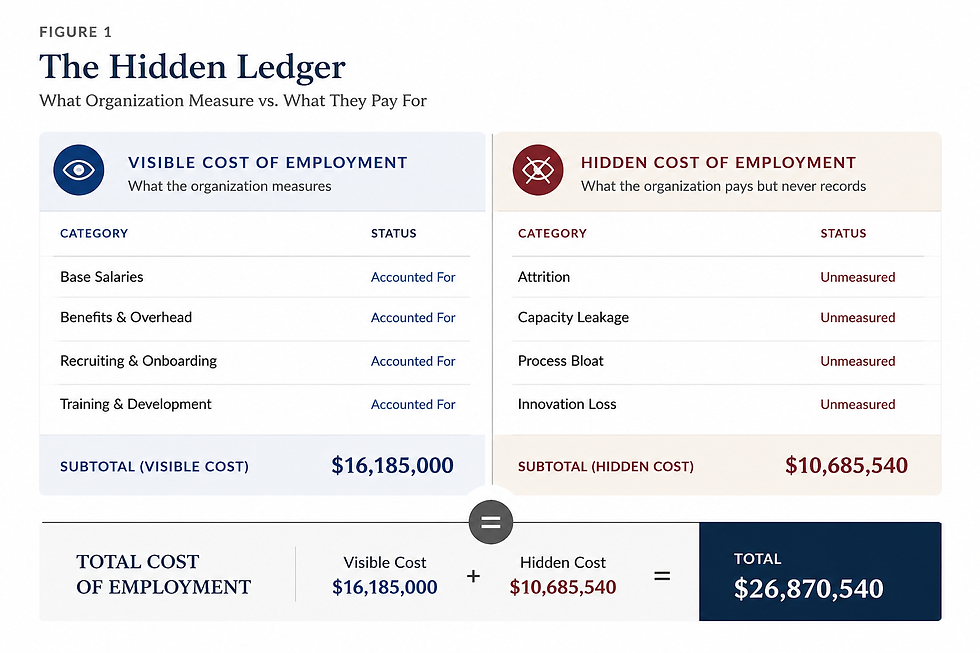
Most organizations maintain detailed systems for tracking the visible costs of employment. Far fewer maintain systems for identifying the costs created when intelligence, expertise, and operational reality cannot move through the organization intact. The result is a hidden ledger of expenses that are paid continuously but rarely measured directly, or in the case of attrition, correctly.
Capacity Leakage is often the first cost to appear and one of the least visible. It emerges when capable employees divert increasing amounts of energy away from productive work and toward managing the conditions surrounding it.
This cost appears most clearly among technically capable individual contributors and systems-level operators whose work requires sustained cognitive complexity. These are the people who can hold multiple environments, client requirements, dependencies, and technical constraints simultaneously and translate that complexity into functional outcomes. Their value does not come from visible effort alone. It comes from maintaining coherent mental models across systems that many others cannot hold at once.
Organizations frequently impose reporting and validation structures intended to make this work legible. The problem is that the effort required to repeatedly document, narrate, justify, and prove value often competes directly with the cognitive conditions required to produce that value in the first place.
A systems architect spending hours reconstructing decision paths for status reporting is not merely performing administrative work. They are reloading cognitive context that had already been allocated to solving the problem itself. An engineer repeatedly required to defend methods that are already producing successful outcomes diverts attention away from the work and toward managing confidence in the work. A consultant carrying complex client environments across multiple applications and dependencies spends increasing amounts of time proving productivity rather than applying it.
This cost compounds. Organizations often treat cognitive labor as infinitely interruptible and fully recoverable. It is neither.
Process Bloat follows naturally. When systems do not trust information to move accurately through existing channels, they compensate by creating additional layers of administration. Duplicate approvals, recurring status meetings, redundant reporting systems, and escalating documentation requirements rarely emerge because the work itself requires them. They emerge because the organization no longer trusts translation to occur reliably without supervision.
Each additional control attempts to compensate for uncertainty created elsewhere in the system. Controls accumulate faster than they disappear. The process layer expands while productive capacity contracts.
Administrative success begins replacing operational success as the system's dominant feedback mechanism.
Innovation Loss emerges next and is frequently mistaken for disengagement or declining creativity.
The people closest to emerging problems learn, often accurately, that raising concerns carries more risk than remaining quiet. A frontline operator watches unresolved concerns redirected into process rather than action. An engineer flags technical debt and sees the conversation move toward prioritization politics instead of technical reality. A manager surfaces operational friction and discovers that explaining the concern requires more effort than carrying the problem privately.
The signal does not disappear. It goes underground.
Organizations then experience a paradox they rarely examine directly: the people closest to operational reality become increasingly silent while leadership simultaneously reports reduced visibility into emerging problems.
Attrition is the final visible cost and the easiest to measure, which is precisely why organizations mistake it for the problem itself.
By the time capable employees leave, the underlying conditions have often existed for years. Capacity has already been leaking. Process has already expanded. Innovation and truthful signal have already slowed.
Departure is rarely the beginning of the expense. It is the point where the accumulated cost becomes impossible to ignore.
A technically capable employee who has spent years carrying excessive reporting burdens, managing preventable friction, and protecting the cognitive conditions required to perform eventually reaches a rational conclusion: the cost of remaining exceeds the cost of leaving.
Organizations record the outcome as turnover and calculate recruiting and replacement costs, but the attrition event itself is only the visible ledger entry attached to a much older organizational debt.
Organizations often normalize voluntary attrition rates between 10 and 15 percent as a routine cost of employment. Normalization and necessity are not the same thing. A more economically defensible baseline is closer to five percent annually: the level reasonably attributable to retirement, relocation, family circumstances, career redirection, and ordinary labor mobility that no organizational system can fully prevent.
Beyond that threshold, attrition deserves closer examination.
When capable employees leave at materially higher rates, the departure is not always evidence of labor market volatility or employee preference. Frequently, it reflects invisible costs created by structural decisions inside the organization itself: capacity erosion, excessive process overhead, interpretive failure, and systems that consume more cognitive and relational labor than they return in productive value.
In this sense, attrition is not merely a workforce metric. It is an economic signal.
Organizations often calculate the replacement cost of turnover while leaving the conditions producing turnover structurally unexamined. The result is a hidden ledger of taxation where employees absorb the costs of system friction silently until departure becomes economically rational for them and financially normalized for the organization.
Ethical leadership is often discussed as a matter of values, character, or decision-making under pressure. Those qualities matter deeply, but they are not the full picture. Ethics also has an architectural dimension.
A system that cannot receive people authentically represses the truth, and that repression is incredibly expensive. It creates conditions where people adapt through silence, self-protection, and strategic conformity. Contrary to popular assumption, this is almost never a failure of character or integrity. People adapt because systems teach them what they can safely bring forward and what they cannot. I call this the Galileo Problem.
Galileo illustrates the mechanism clearly. His observations threatened the interpretive architecture surrounding him. The problem was not simply disagreement. The problem was that acknowledging the truth required destabilizing assumptions the institution depended upon to preserve authority and coherence. Galileo eventually recanted, not because the truth changed, but because survival inside the system required adaptation.
The institution recorded the recantation as resolution. It was not resolution. The truth simply migrated to another system that could receive it.
Organizations reproduce this pattern more quietly every day. Employees learn which concerns are welcomed and which create friction. They learn which observations are rewarded and which require careful translation to survive. They learn which parts of themselves, their expertise, and their judgment can safely surface and which carry professional or social cost.
Most do not become silent because they lack courage. They become strategic because the system teaches them to be. This distinction is hugely important, because human beings are not designed to sustain permanent contradiction between lived reality and permitted reality. Anyone repeatedly required to carry truth into a system that cannot receive it faces the same dilemma eventually: adapt, go silent, or exhaust themselves trying to sustain a reality the system refuses to hold with them.
No one can scream truth into a void indefinitely. Some become cautious. Some withdraw. Some leave. And some continue fighting until the effort itself becomes psychologically destabilizing. The cost is not merely organizational. It is human.
When systems repeatedly punish or repress authentic signal, people adapt accordingly. Fight, flight, or freeze reactions are not abstractions. They are natural human responses to environments experienced as unsafe, unpredictable, or chronically unreceptive. Over time, resistance becomes exhaustion, caution becomes self-protection, and silence becomes less a moral failure than a survival strategy.
This is where leadership becomes more than behavior. It becomes infrastructure.
Healthy organizations do not eliminate friction or disagreement. They build the capacity to interpret it accurately. They create conditions where concerns can surface before they become crises, where difficult information can move without being automatically treated as a threat, and where managers are expected not merely to supervise work but to translate and carry signal responsibly.
The true cost of employment, then, is not simply what an organization spends to hire people.
It is also what the organization loses when the intelligence, perspective, and reality those people carry cannot move through the system intact.
That cost is rarely measured.
It is often the one that matters most.
This article draws from the Hidden Dependency Cost Model developed in Anchoring the System, a forthcoming book by Emily Michaelson. The complete model, including all variables, assumptions, and calculation methodology, will be published in the book's appendix.
Emily Michaelson is a systems thinker who writes about organizational systems, interpretive failure, and the hidden costs of how truth moves through people. Follow her work at shiftingtheanchor.substack.com.


Comments